Lamp of the Goddess by Rae Beth
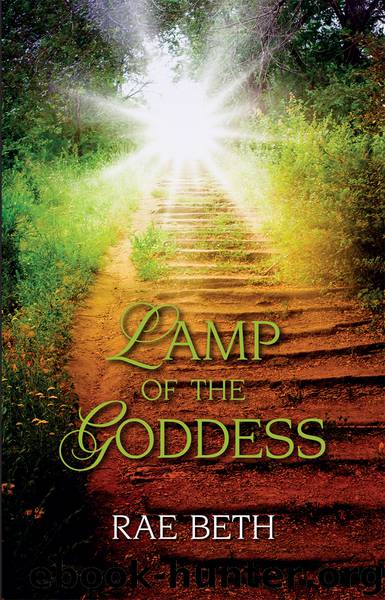
Author:Rae Beth
Language: eng
Format: epub
ISBN: 9780719826887
Publisher: Crowood
Prayer to Persephone:
‘Mysterious Goddess Persephone, Queen of the Dead, we call upon you to bless us in life and death. Annoint us with the oil that you make that gives beauty of the soul, for we know that it is blended with wisdom and love. Let us, like Psyche of old, convey your gift to the Upperworld, so that all our relationships are blessed with beauty and so made sacred.’
MORGAN/THE MORRIGHAN
The mythology of Morgan Le Fay, in Britain, now largely concerns Her life as the half-sister of King Arthur. She was reputedly malicious and destructive, Her skill in witchcraft employed to cause mischief and to further Her unpleasant schemes.
In a world where most other women were supposed to be submissive and sweetly pious, there is something about Morgan that is appealingly nose-thumbing, Despite Her supposed wickedness, it is very hard for women to dislike Morgan Le Fay. Every rebellious woman secretly admires Her - a vamp dressed in black velvet, or wearing purple and gold like a storm cloud and riding a black snake. Who wants to be pale lily-like Guinevere after that? But underneath the distortion of both feminine aspects (Morgan and Guinevere as Dark Goddesss and Bright Goddess of Arthurian tradition) there is concealed an important truth. Morgan was not, at first, seen as evil (any more than Guinevere was originally a wan, hypocritical adultress). In the first recorded account of Morgan’s attributes, given by Geoffrey of Monmouth in his ‘Vita Merlina’, She is described as living with Her eight sisters in a realm far across the sea - an Otherworldly island - and is a healer whose skills are second to none. She can also change shape and fly through the air to wherever She wants, and is learned and beautiful. After the Battle of Camlan, She receives the fatally wounded Arthur and promises to heal him.
There is no mention here of malice or emnity. However, the later texts (especially Malory’s Morte d’Arthur) describe bitter conflict between Morgan and the king. As shown in the popular novel Mists of Avalon by Marian Bradley, it is possible to interpret this as a theme based on priestesses defending the ancient faith of the Goddess against a male sovereign championing Christianity. In my belief, there may have been a priestess of Avalon (the island sanctuary of the Goddess Morgan) who fought hard against Christian displacement of the old Pagan faith. This priestess may have been known as Morgan, in much the same way that nuns are called Mary - as a sign of vocation. She may or may not have been half-sister to the king. She may or may not have existed historically as an individual person, for her tale may symbolize feelings and political actions of a great many women. But the mythology of Morgan may contain this strand, as well as those of Goddessly beauty and wisdom and healing power - the heroine-tales of a priestess or priestesses defending the old beliefs and the right to Goddess-worship.
It has
Download
This site does not store any files on its server. We only index and link to content provided by other sites. Please contact the content providers to delete copyright contents if any and email us, we'll remove relevant links or contents immediately.
Becoming Supernatural by Dr. Joe Dispenza(8225)
Crystal Healing for Women by Mariah K. Lyons(7935)
The Witchcraft of Salem Village by Shirley Jackson(7280)
Inner Engineering: A Yogi's Guide to Joy by Sadhguru(6799)
The Four Agreements by Don Miguel Ruiz(6770)
The Power of Now: A Guide to Spiritual Enlightenment by Eckhart Tolle(5790)
Secrets of Antigravity Propulsion: Tesla, UFOs, and Classified Aerospace Technology by Ph.D. Paul A. Laviolette(5374)
The Wisdom of Sundays by Oprah Winfrey(5168)
Room 212 by Kate Stewart(5130)
Pale Blue Dot by Carl Sagan(5013)
Fear by Osho(4743)
The David Icke Guide to the Global Conspiracy (and how to end it) by David Icke(4723)
Animal Frequency by Melissa Alvarez(4477)
Rising Strong by Brene Brown(4467)
How to Change Your Mind by Michael Pollan(4360)
Sigil Witchery by Laura Tempest Zakroff(4250)
Man and His Symbols by Carl Gustav Jung(4140)
Real Magic by Dean Radin PhD(4134)
The Art of Happiness by The Dalai Lama(4133)
